Chaos Over Water: The Wild Evolution of Track's Most Unpredictable Race
From Horses to Humans: The Strangest Origin Story in Track
Picture this: 18th-century British gentlemen, probably slightly drunk, watching horses race across muddy countryside and thinking, "You know what would make this better? If humans did it instead." That's essentially how the steeplechase was born—a sport so wonderfully absurd that it somehow survived long enough to become an Olympic event.
The name itself tells the story. Early races literally went from church steeple to church steeple across the English countryside, with participants leaping over whatever obstacles lay in their path: stone walls, streams, hedges, and the occasional bewildered sheep. It was less a sporting event than organized chaos with a finish line.
When track and field officials decided to domesticate this madness for stadium use, they created something that still doesn't quite make sense: a 3,000-meter race interrupted by 28 fixed barriers and seven water jumps that turn elite runners into flailing, soaking disasters.
The American Steeplechase Struggle
For decades, American men treated the steeplechase like that weird cousin nobody talks about at family reunions. While we dominated sprints and field events, the steeplechase remained stubbornly foreign, controlled by athletes from countries where jumping over things while running apparently made more sense.
The problem wasn't physical—American distance runners could handle 3,000 meters just fine. The issue was cultural. American track and field developed around precise, measured events: the 1500 meters, the 5,000, the 10,000. These were races you could train for scientifically, with split times and pacing strategies.
The steeplechase, meanwhile, was pure chaos theory in spikes. You could run negative splits all day, but if you mistimed a water jump, you'd spend the next 200 meters sloshing around in wet shoes while East African runners disappeared into the distance.
The Physics of Disaster
What makes the steeplechase so uniquely challenging isn't just the obstacles—it's how they disrupt everything else about distance running. Modern sports science has broken down exactly why this event destroys even elite athletes.
The barriers force runners to decelerate, jump, and accelerate again every 78 meters. That's like asking a Formula One driver to hit the brakes and gun it 35 times during a single race. The energy expenditure is enormous, but more importantly, it's unpredictable.
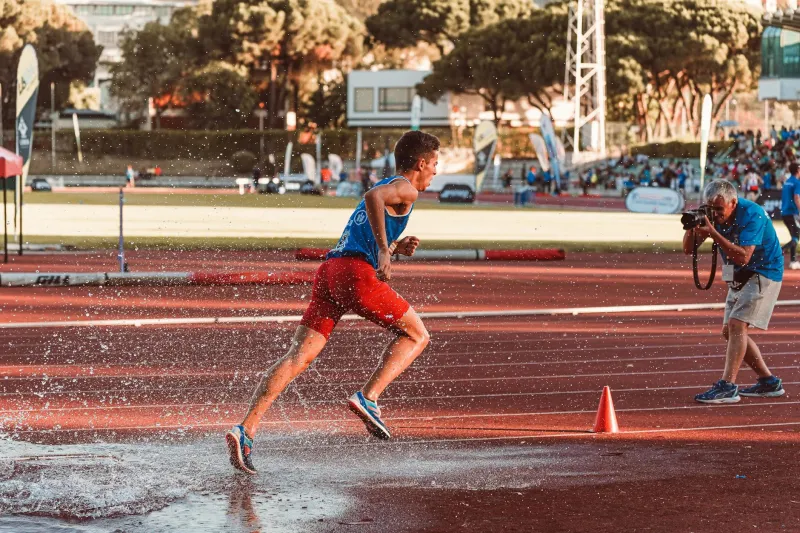
The water jump is pure evil disguised as an obstacle. Runners approach at race pace, hurdle a barrier, then land in 12 inches of water that instantly transforms their gait into something resembling a wounded giraffe. The shock to the legs is massive, but the psychological impact is worse—suddenly, elite athletes feel clumsy and out of control.
East African Dominance and American Bewilderment
While Americans struggled to figure out the steeplechase, East African runners embraced its chaos with supernatural calm. Kenyan and Ethiopian athletes didn't just win—they made it look easy, floating over barriers while American runners crashed into them like caffeinated deer.
The secret wasn't mystical. East African runners grew up in environments where navigating obstacles was part of daily life. Running to school meant jumping streams, dodging livestock, and maintaining pace over uneven terrain. The steeplechase wasn't a weird track event—it was Tuesday afternoon.
American runners, trained on perfectly measured tracks with scientifically calibrated workouts, approached the steeplechase like a math problem. East Africans treated it like a dance. Guess who looked better doing it?
The Technical Revolution
Modern steeplechase technique bears little resemblance to its chaotic origins. Today's elite runners have turned obstacle navigation into an art form, using barriers as springboards rather than impediments.
The water jump technique alone represents decades of evolution. Early steeplechasers would hurdle the barrier and land deep in the water, creating massive splash zones and destroying their rhythm. Modern athletes barely touch the water, using the barrier to launch themselves to the far edge of the pit.
But here's what makes the steeplechase eternally unpredictable: even perfect technique can't eliminate the chaos factor. Pack running over barriers creates traffic jams that would make rush hour look organized. One mistimed step can trigger a domino effect that takes out half the field.
The American Renaissance
Recent years have seen American steeplechasers finally crack the code, led by athletes who embraced the event's inherent weirdness rather than fighting it. Evan Jager and Emma Coburn didn't just train for the steeplechase—they lived it, practicing barrier technique until it became as natural as breathing.
 Photo: Evan Jager, via upload.wikimedia.org
The breakthrough came from treating the steeplechase as its own sport rather than distance running with obstacles. American coaches developed steeplechase-specific training programs, built practice water jumps, and most importantly, taught athletes to love the chaos instead of fearing it.
Why the Steeplechase Matters
In an era of increasingly specialized athletics, the steeplechase remains beautifully, stubbornly unpredictable. It's the event where race favorites can trip over their own feet, where unknown runners can steal victories with perfect timing, and where the best-laid race plans dissolve in a splash of water.
The steeplechase represents something pure about competition: the understanding that not everything can be controlled, measured, or predicted. Sometimes, the best athlete isn't the one with the fastest personal best—it's the one who can adapt to chaos while everyone else is falling apart.
The Enduring Appeal of Organized Chaos
There's something deeply satisfying about watching elite athletes get humbled by a puddle of water. The steeplechase reminds us that even superhuman performers are still human, still capable of spectacular failure in the pursuit of spectacular success.
More than that, it's a race that rewards qualities you can't train in a lab: adaptability, courage, and the willingness to look ridiculous in pursuit of glory. In a sport increasingly dominated by sports science and marginal gains, the steeplechase remains refreshingly, chaotically human.
Every time the field approaches that water jump, anything can happen. And in track and field, that's exactly what makes it beautiful.