From Spear to Science: The Javelin's Journey From Ancient Battlefield to Olympic Precision
From Spear to Science: The Javelin's Journey From Ancient Battlefield to Olympic Precision
Picture this: It's 708 BC in ancient Olympia, and Greek warriors are demonstrating their battlefield prowess by hurling actual spears as far as their trained arms can manage. Fast-forward 2,700 years, and athletes are launching precisely engineered projectiles over 300 feet using techniques so refined they'd make those ancient competitors' heads spin.
The javelin throw represents one of sport's most dramatic evolutionary stories—a transformation from raw military training into a event where millimeters of grip placement and degrees of release angle separate Olympic champions from also-rans.
When War Training Became Competition
The javelin entered the ancient Olympics as part of the pentathlon, alongside running, wrestling, long jump, and discus. But unlike modern track and field, this wasn't about personal bests or world records. Greek athletes threw actual war spears, some weighing up to four pounds—nearly twice the weight of today's men's javelin.
These ancient competitors weren't just showing off. The javelin throw served as practical military preparation in a world where spear-throwing accuracy could mean the difference between victory and defeat on actual battlefields. Archaeological evidence suggests some ancient Greek javelins measured over eight feet long, making them unwieldy by today's standards but perfectly suited for combat training.
The ancient technique was surprisingly sophisticated. Competitors used a leather strap called an "amentum" wound around the javelin's shaft, which acted like a sling to increase throwing distance and accuracy. This early biomechanical enhancement could add 30% more distance to a throw—ancient Greece's version of performance technology.
The Modern Makeover
When Baron Pierre de Coubertin revived the Olympics in 1896, the javelin throw made the cut as one of track and field's core events. But the implement itself underwent radical changes. The modern javelin became lighter, more aerodynamic, and standardized—men's javelins now weigh exactly 800 grams (about 1.76 pounds) while women's weigh 600 grams.
The real revolution came in technique. Ancient throwers relied primarily on raw strength and basic mechanics. Modern javelin throwers approach their craft like aerospace engineers, calculating optimal release angles (typically between 35-40 degrees), runway speeds (often exceeding 20 mph), and body positioning that maximizes kinetic energy transfer.
The Throw That Broke the Sport
By the 1980s, javelin technology and technique had evolved so dramatically that the sport faced an existential crisis. East German athlete Uwe Hohn launched a throw of 104.80 meters (343 feet, 10 inches) in 1984—a distance so extreme it nearly flew out of Berlin's Olympic Stadium entirely.
That throw terrified officials. Stadiums weren't designed for 350-foot javelin throws. Spectators, officials, and other athletes were potentially at risk from these missile-like projectiles. Something had to change.
In 1986, the International Association of Athletics Federations made a unprecedented decision: they redesigned the javelin itself. The new implement moved the center of gravity forward by four centimeters, fundamentally altering its aerodynamics and flight characteristics. This change reduced throwing distances by approximately 10%, bringing the event back within manageable stadium dimensions.
Hohn's record was grandfathered in, but all subsequent throws would use the new design. Today's world record of 98.48 meters, set by Jan Železný in 1996, represents the pinnacle of achievement with the modified javelin.
Ancient Arms vs. Modern Missiles
The performance gap between ancient and modern javelin throwers reveals just how dramatically human athletic capability has evolved. While precise measurements from ancient competitions don't exist, historical accounts and archaeological reconstructions suggest the best ancient throwers might have reached distances of 60-70 meters with their heavier, less aerodynamic spears.
Today's elite throwers routinely exceed 85 meters, representing improvements of 25-30% despite using lighter implements. This gap reflects advances in training methodology, sports science, nutrition, and biomechanical understanding that ancient athletes couldn't have imagined.
Modern javelin throwers train year-round with specialized coaches, analyze their technique using high-speed video, and follow periodized training programs that optimize strength, speed, and technical precision. Ancient competitors, by contrast, trained as part of broader military preparation, focusing on functional strength rather than event-specific optimization.
The Science of the Perfect Throw
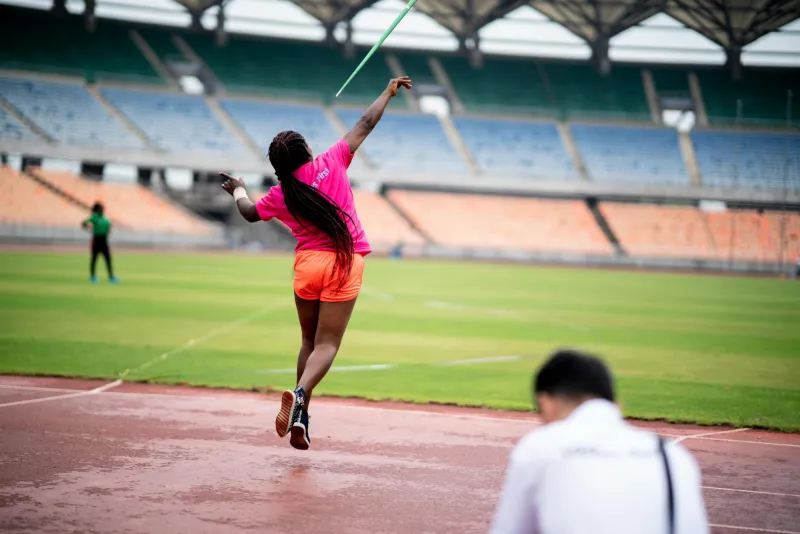
Today's javelin throw represents a masterclass in applied physics. Elite throwers must coordinate a complex sequence of movements: an accelerating runway approach, a precise crossover step pattern, and a whip-like throwing motion that generates incredible rotational and linear forces.
The modern javelin's design reflects decades of aerodynamic research. Its tapered shape, specific weight distribution, and surface texture all contribute to optimal flight characteristics. The implement must maintain stability in flight while maximizing distance—a delicate balance that requires precise engineering.
Wind conditions, air density, and even altitude affect javelin flight paths. Elite competitors study weather patterns and adjust their technique accordingly, something ancient Greek warriors throwing in Mediterranean breezes never needed to consider.
Why Ancient Warfare Created Modern Excellence
The javelin's evolution from military training to Olympic sport illustrates how human competitive drive transforms practical skills into pure performance art. What began as soldiers preparing for battle became athletes pushing the absolute limits of human throwing capability.
This transformation reflects a broader pattern in athletics: events rooted in practical human activities—running from danger, jumping over obstacles, throwing weapons—become laboratories for exploring human potential once survival needs are removed.
Today's javelin throwers may never face ancient Greek battlefields, but they've inherited that warrior tradition of turning physical capability into competitive advantage. They've simply added 2,700 years of scientific advancement to the mix.
The next time you watch a javelin competition, remember: you're witnessing the latest chapter in humanity's longest-running experiment in turning warfare into sport. And based on the precision and distances modern athletes achieve, that experiment continues to yield remarkable results.