Sweat, Steel, and Strategy: How Ancient Greece Invented Athletic Training for War — and the US Military Never Forgot
Sweat, Steel, and Strategy: How Ancient Greece Invented Athletic Training for War — and the US Military Never Forgot
Walk into any Division I athletic facility in America today and you'll find something the ancient Greeks would have recognized immediately: a room full of young men and women being pushed to their physical limits, not purely for the love of competition, but because someone believes that physical excellence produces a certain kind of person. Disciplined. Resilient. Hard to break under pressure.
The Greeks had a word for it — arete — roughly translated as excellence or virtue. And they built an entire athletic culture around the belief that the body and the warrior were inseparable.
The Gymnasium Was a Military Installation
In ancient Greece, the gymnasium wasn't a place you went to stay in shape between seasons. It was a civic institution, funded by city-states, operated under the supervision of trained coaches called paidotribes, and explicitly designed to produce men capable of fighting and winning wars.
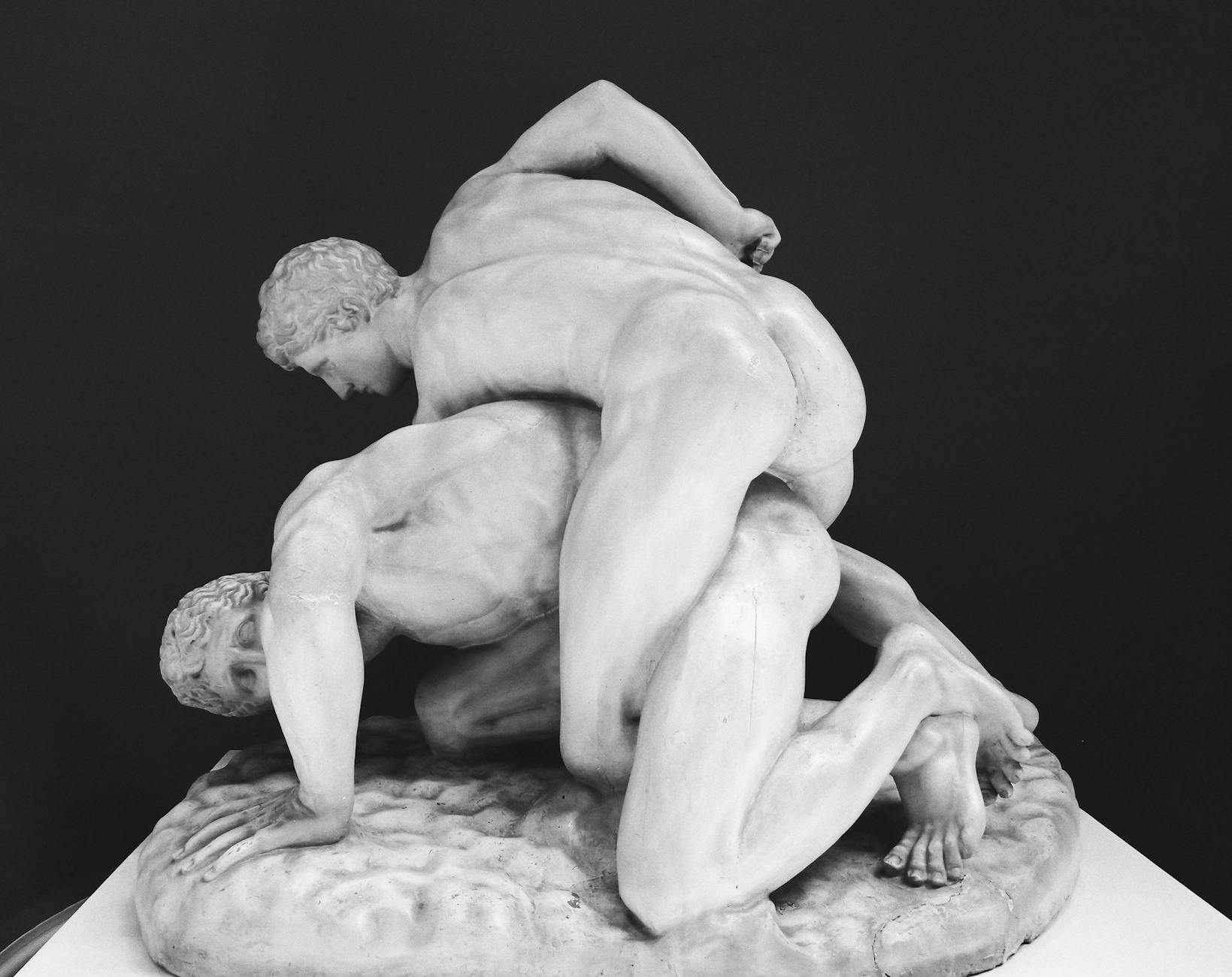
The events of the ancient Olympic Games weren't chosen randomly. The stadion sprint — a roughly 200-meter dash — trained soldiers to close distance on an enemy or retreat quickly. The dolichos, a long-distance race of anywhere from 7 to 24 laps of the stadium track, built the kind of endurance a soldier needed to march, fight, and march again. Wrestling and the pankration — a brutal combination of wrestling and striking with almost no rules — were direct simulations of close-quarters combat.
Then there was the pentathlon, arguably the most revealing event of all. Five disciplines: the long jump, discus throw, javelin throw, sprint, and wrestling. Look at that list and you're not looking at an athletic competition — you're looking at a battlefield skills assessment. The javelin was a weapon. The discus throw trained the arm mechanics used to hurl projectiles. The long jump built the explosive leg power needed to cross terrain under pressure. The pentathlon wasn't designed to find the best all-around athlete. It was designed to find the best all-around soldier.
City-states like Sparta made no attempt to disguise this connection. Spartan athletic training was militaristic to a degree that made other Greek city-states look soft. Boys began physical conditioning at age seven. By their early teens, they were competing in combat sports as preparation for a military service obligation that would define their entire adult lives.
The Hoplite on the Starting Line
One of the most striking events in the ancient Olympics was the hoplitodromos — the race in armor. Competitors ran the length of the track wearing a helmet and carrying a heavy shield, sometimes also wearing greaves on their legs. There was no ambiguity about what this event was training for. These were soldiers running in the equipment they would wear into battle, being timed and ranked in front of thousands of spectators.
It's a detail that gets lost when people romanticize the ancient Games as a celebration of pure athletic beauty. Yes, there was artistry in the discus throw. Yes, the fastest sprinters were celebrated like rock stars. But the entire enterprise was wrapped around a military purpose. Physical competition was how Greek city-states produced, identified, and celebrated the men they needed to survive.
America's Military and the Athletic Tradition
Fast forward about 2,300 years, and the United States Army is standing at a similar crossroads. In the late 19th century, as the U.S. military was modernizing and professionalizing, military leaders began formalizing athletic programs that would have felt familiar to an ancient Greek strategist.
The Army Athletic Association was established in the 1890s, promoting competitive sport across military installations as a tool for building fitness, morale, and unit cohesion. The logic was nearly identical to what the Greeks had practiced: competition reveals character, physical training builds the kind of resilience that holds up when things get difficult, and an athlete who performs under pressure is more likely to be a soldier who performs under pressure.
The service academies — West Point, the Naval Academy at Annapolis, and the Air Force Academy in Colorado Springs — institutionalized this philosophy at the highest level. Athletics at these schools have never been purely about winning football games or track meets. They've always been framed as character development, leadership training, and the cultivation of physical and mental toughness that transfers directly to military command.
The results have shown up at the Olympics for generations. West Point and the Naval Academy have produced a remarkable number of Olympic athletes across multiple sports, particularly in wrestling, boxing, and track and field — the events most directly connected to the ancient Greek model of warrior-athlete training.
The Modern NFL-Military Partnership
The relationship between American sport and military culture runs even deeper than the service academies. The NFL's long-standing partnership with the Department of Defense — which has included everything from flyovers and on-field tributes to paid promotional arrangements — reflects a cultural assumption that elite athletic competition and military service share a common identity. Both demand sacrifice. Both reward discipline. Both produce a specific kind of toughness that American culture has historically celebrated.
Critics have pointed out, fairly, that the NFL-military relationship has sometimes been more about marketing than genuine shared values. But the underlying instinct — that athletic competition and military preparedness are connected — is ancient. The Greeks weren't the last civilization to notice it. They were just the first to build a formal system around it.
The modern Army Combat Fitness Test, which replaced the older Army Physical Fitness Test in 2020, includes events like the sprint-drag-carry, a sequence of movements explicitly designed to simulate battlefield tasks. It's a direct descendant of the hoplitodromos logic: don't just test whether soldiers can run — test whether they can perform physically in conditions that reflect what combat actually demands.
The Record That Connects Them
At Race The Record, we spend a lot of time thinking about how athletic performance has changed over millennia. The times get faster. The techniques get more refined. The science gets more sophisticated. But some things haven't changed at all.
The ancient Greeks believed that the best athletes and the best soldiers were shaped by the same forces: deliberate training, competitive pressure, and the relentless pursuit of physical excellence. Thousands of years later, a cadet at West Point running a sprint-drag-carry in the rain is chasing the exact same idea.
The events are different. The equipment is different. The stakes, thankfully, are often different. But the philosophy that sport builds warriors — and that warriors, in turn, make the best competitors — has never really gone away. It just changed uniforms.