The Game That Predates the Olympics by Centuries — and Still Can't Get America's Full Attention
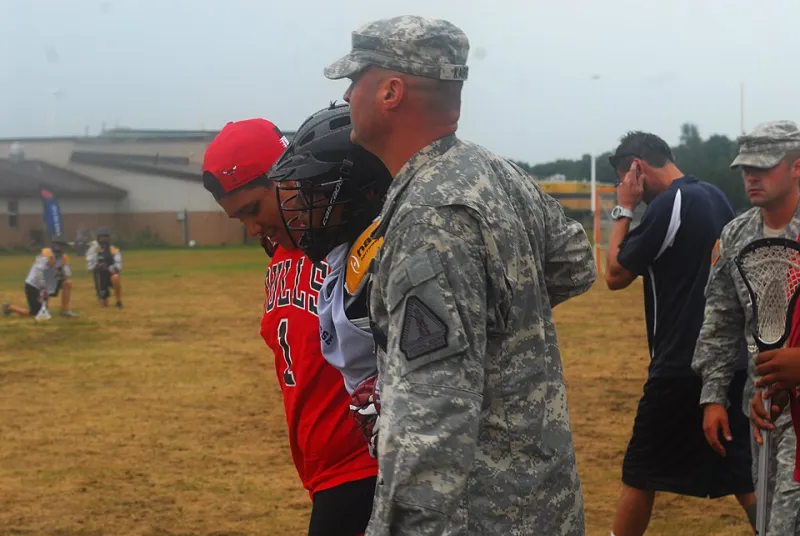
Photo: Master Sgt. Daniel Ewer, Public domain, via Wikimedia Commons
The Game That Predates the Olympics by Centuries — and Still Can't Get America's Full Attention
When we talk about the origins of organized sport, the conversation almost always starts in ancient Greece. The stadion race at Olympia. The discus. The wrestling pit. It's a tidy origin story, and it's not wrong — but it's incomplete.
Because long before any Greek athlete stripped down and sprinted across a sacred track, Indigenous nations across North America were playing a sport of extraordinary complexity, physical demand, and spiritual depth. A sport that could cover miles of terrain, involve hundreds of players, and last for days at a stretch. A sport that European colonists watched in stunned bewilderment before eventually borrowing it, repackaging it, and sending it to the Olympics — twice — before more or less forgetting where it came from.
That sport is lacrosse. And its story is one of the most underappreciated in American athletic history.
A Game Born From Something Much Larger Than Sport
The Indigenous version of lacrosse — known by dozens of different names across different nations, including the Creator's Game and Tewaarathon — wasn't primarily athletic entertainment. It was ceremony. It was diplomacy. It was preparation for war and, in some traditions, a direct offering to the Creator.
For nations including the Haudenosaunee (Iroquois), Ojibwe, Cherokee, and dozens of others, the game served purposes that had nothing to do with winning for its own sake. Disputes between communities could be settled on the playing field rather than the battlefield. Players trained for months, submitting to dietary restrictions and spiritual rituals that would look familiar to any modern athlete preparing for a major competition — even if the framework was entirely different.
The playing fields were not measured or standardized. They could stretch for a mile or more between goalposts. The number of players on each side varied wildly — sometimes dozens, sometimes hundreds. A game could begin at sunrise and continue through the following day. Injuries were expected. Deaths occurred.
In terms of physical demand, this wasn't recreation. It was a full-body test of endurance, agility, and pain tolerance that would humble most modern athletes.
The French Name and the Colonial Lens
When French missionaries and traders first encountered the game in the 17th century, they did what colonizers typically did — they renamed it. The curved stick reminded them of a bishop's ceremonial staff, la crosse in French. The name stuck, even as the cultural context it came from was systematically stripped away.
By the 19th century, Canadian colonists had adopted a modified version of the game, standardized the rules, reduced the field size, and turned it into something recognizable as a modern sport. In 1867, the same year Canada became a confederation, lacrosse was declared the country's national sport. The Indigenous origins of the game were acknowledged, but mostly as a quaint historical footnote rather than an ongoing living tradition.
The Haudenosaunee, whose ancestors had played the game for centuries, watched their creation get formalized and exported by people who had learned it from them.
Two Olympic Appearances and a Long Absence
Lacrosse made it to the Olympics — twice. And both appearances tell you something about how the sport was perceived at the time.
At the 1904 St. Louis Games, lacrosse was a demonstration event. Three teams competed, two of them Canadian and one a Mohawk team from the Haudenosaunee Confederacy. The Canadians won. The event drew modest attention in a Games that was, by most historical accounts, a disorganized spectacle that also featured events like "Anthropology Days" — a deeply troubling segment in which Indigenous and other non-Western peoples were made to compete in athletic events as a kind of racial exhibition. The 1904 Olympics were not the sport's finest hour.
 Photo: St. Louis, via www.thoughtco.com
Lacrosse returned in 1908 at the London Games, again as a formal event, with Canada defeating Great Britain for the gold. And then it disappeared from the Olympic program entirely, a casualty of the IOC's periodic culling of sports that lacked sufficient global participation.
For nearly a century, lacrosse existed outside the Olympic framework — growing steadily in the United States as a prep school and college sport, but never quite achieving the mainstream recognition of football, basketball, or baseball.
The Haudenosaunee Passport Dispute
One of the most revealing episodes in modern lacrosse history has nothing to do with a game. It happened in 2010, when the Haudenosaunee Nationals — the Indigenous team representing the Iroquois Confederacy — were denied entry to the United Kingdom for the Lacrosse World Championships because British authorities wouldn't accept their Haudenosaunee passports.
The team had been traveling on those passports since 1990. The dispute forced them to withdraw from the tournament, and it lit up a conversation about sovereignty, identity, and the complicated relationship between Indigenous nations and the international sporting world.
For a sport whose very existence traces back to Haudenosaunee tradition, the idea that the people who created it would be denied participation in its global championship based on passport technicalities was — to put it mildly — a difficult thing to sit with.
The Modern Comeback
Lacrosse is returning to the Olympics. It was approved for the 2028 Los Angeles Games, which means the sport will make its first full Olympic appearance in over a century on American soil — a detail that carries a weight of historical irony that's hard to overstate.
The growth of the sport at the youth and collegiate level in the U.S. has been significant. Participation numbers have surged over the past two decades, particularly in suburban and affluent communities. The Premier Lacrosse League, launched in 2019, has worked to build a professional infrastructure that the sport previously lacked.
The Haudenosaunee Nationals are expected to compete at LA28 — representing not a nation-state recognized by the United Nations, but the original custodians of the game itself. Their participation will be, depending on how you look at it, either a long-overdue acknowledgment or a complicated compromise. Probably both.
Racing Back to the Beginning
There's something fitting about a sport this old returning to the Olympic stage at this particular moment. American sports culture tends to have a short memory — we celebrate what's current and move fast past what came before.
But lacrosse is a reminder that the history of athletic competition on this continent didn't begin with the modern Olympics, or with European settlers, or with any of the founding myths we're most comfortable with. It began much earlier, on open fields, with sticks and a ball and a spiritual purpose that most modern sports have long since abandoned.
The records we race toward at this site are almost always measured in seconds and centimeters. Lacrosse, in its original form, was measured in something harder to quantify — endurance, community, and meaning.
That's a different kind of record. And it's been standing for a very long time.