Frozen in Time: The Scientific Case for Why 9.58 Might Be the Last Number That Ever Matters in Sprinting
There's a number burned into the memory of anyone who watched the 2009 World Championships in Berlin: 9.58. Usain Bolt crossed the line, turned to look at the clock, and the scoreboard confirmed what had just happened. The 100-meter world record hadn't just been broken — it had been demolished. His previous record of 9.69 from the Beijing Olympics felt suddenly ancient.
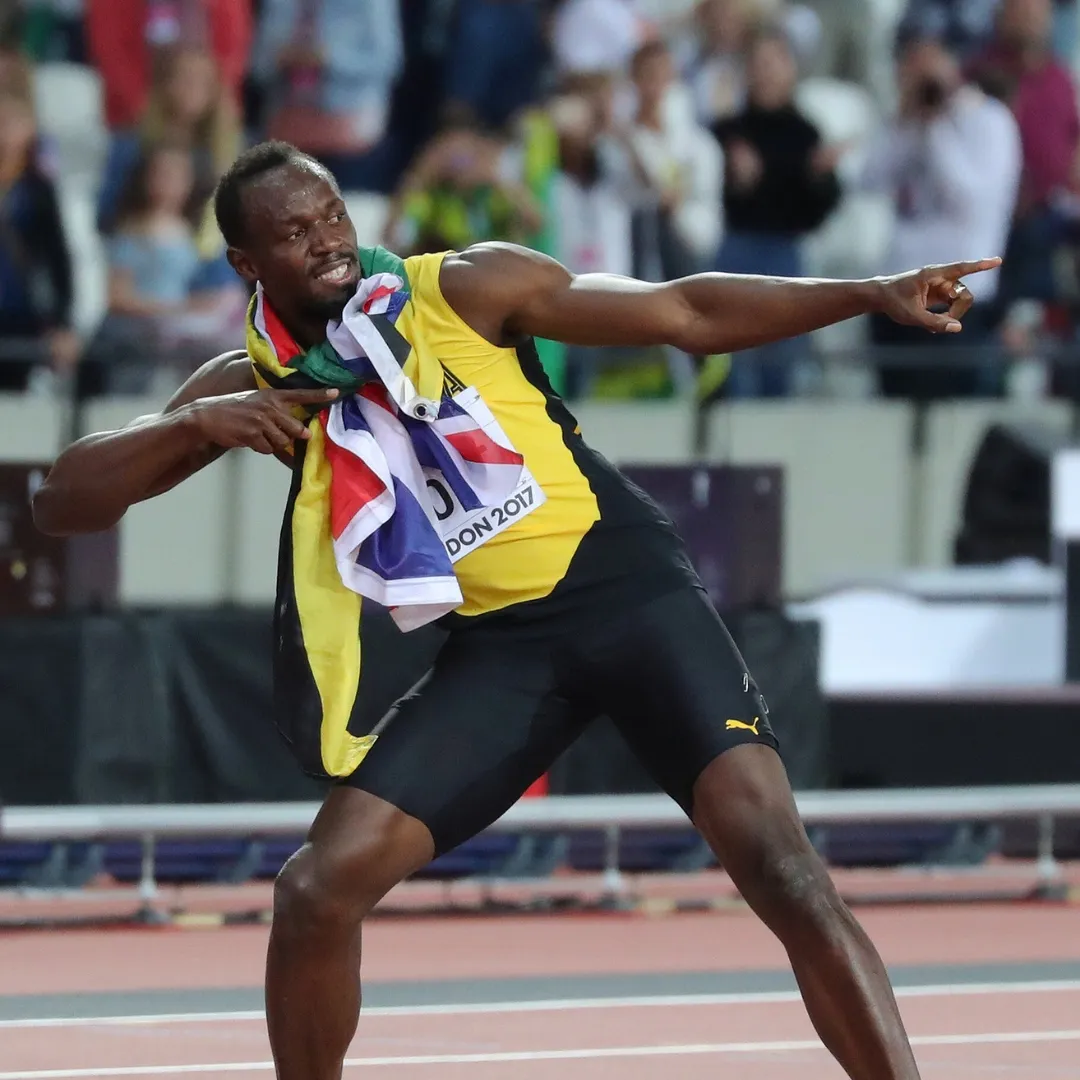 Photo: Usain Bolt, via www.drworkout.fitness
In the years since, elite sprinters have lined up in lane after lane, race after race, chasing that number. None of them have touched it. Some haven't even gotten close.
The question the sport is quietly starting to ask isn't "who will break 9.58?" It's whether anyone ever will.
How Fast Records Used to Fall
To understand why the current stagnation is so striking, you need to look at how quickly the 100-meter record moved through the 20th century.
In 1912, the world record stood at 10.6 seconds. By 1936, Jesse Owens had pushed it to 10.2. By 1968, Jim Hines had cracked the 10-second barrier for the first time, running 9.95 in Mexico City. Over those 56 years, roughly half a second had been carved off the record — a pace of improvement that felt, if not unlimited, at least consistently forward-moving.
 Photo: Jesse Owens, via lapvip.vn
From 1968 to 1991, the record dropped another quarter second, to 9.86 courtesy of Carl Lewis. By 2005, Asafa Powell had it down to 9.77. In 2008, Bolt ran 9.69 in Beijing. In 2009, 9.58 in Berlin.
That's a dramatic acceleration of improvement — and then, almost immediately, a wall.
In the 15-plus years since Berlin, the record has not moved by a single hundredth of a second. In a sport where improvement used to arrive on a near-annual basis, that kind of stagnation is historically unusual.
What the Biomechanists Are Saying
Sports scientists who study human locomotion have been poking at this question for years, and their findings are sobering for anyone hoping to see 9.57 on a scoreboard.
At peak velocity — which elite sprinters reach somewhere between 60 and 80 meters — Bolt was covering ground at roughly 12.4 meters per second. That's about 27.8 miles per hour. To run appreciably faster, a human body would need to either increase stride frequency, increase stride length, or both.
Here's the problem: both of those variables are approaching physiological limits. Stride frequency is constrained by how quickly the nervous system can fire the muscles required for each ground contact. Stride length is constrained by the mechanical efficiency of the hip flexors and the angle at which force can be applied to the ground. Neither of these is infinitely scalable.
Research published in the Journal of Experimental Biology has modeled the theoretical maximum speed of human sprinting based on the force that fast-twitch muscle fibers can apply during the brief ground contact phase of each stride. The numbers suggest that 9.58 is operating very close to the edge of what human anatomy can deliver under legal conditions.
The Statistical Picture
Beyond biomechanics, statisticians have approached the problem from a different direction — and arrived at a similar destination.
When you plot the progression of the 100-meter world record over time, the curve doesn't move in a straight line. It flattens. The rate of improvement slows as performance approaches what mathematicians call an asymptote — a theoretical limit that the curve approaches but never quite reaches.
Different modeling approaches produce slightly different numbers for that asymptote, but most cluster somewhere between 9.4 and 9.6 seconds. Bolt's 9.58 sits uncomfortably close to the upper end of that range.
This isn't a new phenomenon. The same kind of asymptotic flattening has been observed in swimming, cycling, and weightlifting. Every human performance sport eventually runs up against the physical constraints of the bodies doing the performing.
The Conditions That Made 9.58 Possible
It's also worth considering that Bolt's record wasn't just a product of extraordinary genetics. It was a product of everything coming together perfectly — a legal tailwind of 0.9 meters per second, a fast track, a global championship atmosphere that produced the kind of competition-driven effort that training alone can't replicate, and a 22-year-old body at the absolute peak of its physical development.
Bolt himself never came close to 9.58 again after Berlin. He ran 9.63 to win the London Olympics in 2012 — still the second-fastest time in history — but the Berlin run remained singular. Even for the greatest sprinter who ever lived, 9.58 was a performance he could produce once.
For anyone else to break it, they'd need not just Bolt's talent, but Bolt's perfect day.
The Shoe Question
No conversation about modern sprinting records can fully avoid the equipment variable. The carbon-fiber plate technology that transformed marathon running over the last decade has prompted legitimate questions about whether similar innovations in sprint spikes could unlock new levels of performance on the track.
World Athletics has implemented regulations around spike design, but the arms race between footwear companies and governing bodies is ongoing. Some researchers believe that optimized sprint footwear could theoretically shave a few hundredths off top-end times. Whether that would be enough to crack 9.58 is genuinely unclear — and whether such a result would feel like a pure human achievement is a philosophical question the sport hasn't fully answered.
What Stagnation Means for the Sport
There's something philosophically interesting about a world record that might simply be permanent. Most sports records exist in a state of anticipatory tension — everyone assumes they'll eventually fall. The four-minute mile fell. The 10-second barrier fell. Progress is supposed to be the natural direction of travel.
But 9.58 has started to feel different. It doesn't feel like a record waiting to be broken. It feels like a finishing line — the moment when the human body reached the edge of its own capability and stopped.
For the sprinters still chasing it, that's an uncomfortable thought. For the rest of us watching, it's a reminder that every race has a limit.
Bolt found his on a warm August night in Berlin. The clock stopped. And so, perhaps, did the record.